The Circle Line is one of the most practical London Underground lines for tourists because it links many of the city’s best-known central districts, landmarks and railway stations in a simple loop. If you want to move between Paddington, King’s Cross St Pancras, Liverpool Street, Tower Hill, Westminster, Victoria, South Kensington and Notting Hill, the Circle Line is often one of the easiest Tube options to understand and use.
It is not always the fastest line for every journey, but it is one of the easiest to understand from a visitor’s point of view. That makes it especially useful for first-time travellers in London who want a simple way to move between major attractions and central transport hubs.
Quick answer: is the Circle Line useful for tourists?
- Best for: central London sightseeing, major landmarks and rail connections
- Main strength: easy access to many important central stations and attractions
- Best use case: moving around central London without overcomplicating your route
- Line colour: Yellow
- Good to know: the Circle Line is convenient, but not always the fastest option compared with more direct lines
Circle Line map
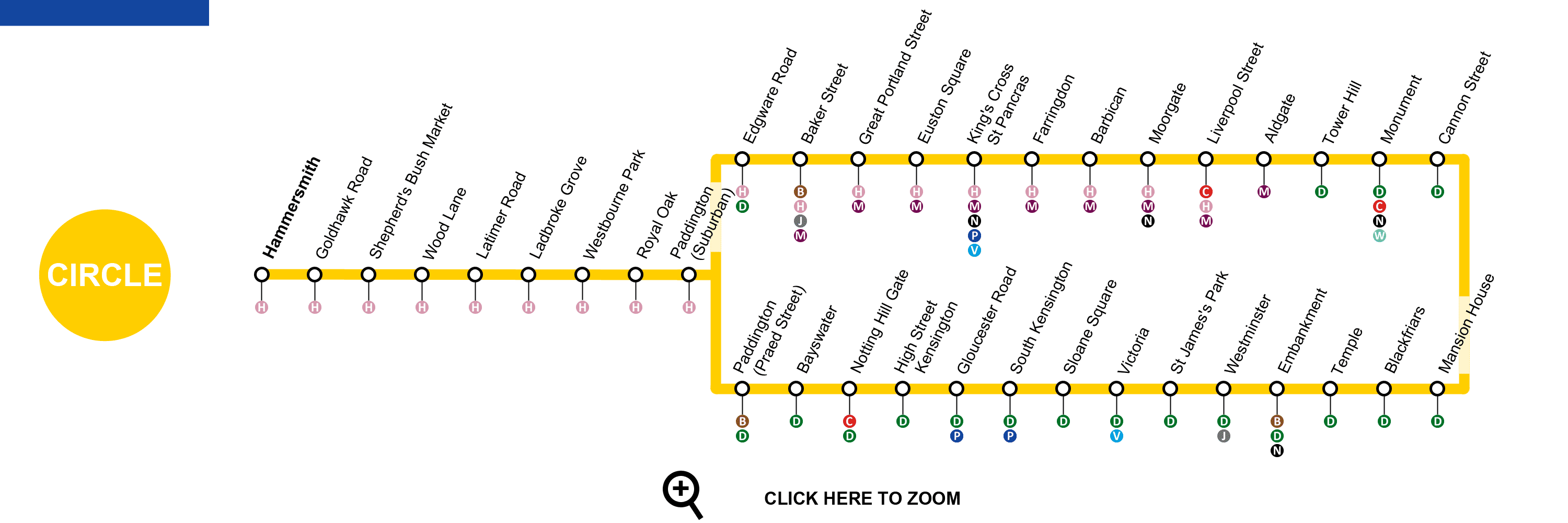
Circle Line overview
The Circle Line is one of the most recognisable London Underground lines because it runs around central London in a loop before continuing west towards Hammersmith. For visitors, that loop is extremely useful because it connects some of the city’s main landmarks, railway stations and tourist districts in a simple and memorable way.
Unlike some lines that are mainly useful for commuters or very specific parts of London, the Circle Line is strongly connected to the visitor experience. It links stations used for museums, royal landmarks, Westminster sightseeing, Tower of London visits, rail arrivals, Eurostar connections and hotel areas around Paddington. That is why many tourists use it at least once during their stay, even if they do not realise it in advance.
- Main tourist value: easy central London coverage
- Main central stations: Paddington, Baker Street, King’s Cross St Pancras, Liverpool Street, Tower Hill, Westminster, Victoria, South Kensington
- Best for: sightseeing, simple journeys and station-to-station travel around central London
- Less ideal for: journeys where another line offers a faster direct route
Why the Circle Line is useful for tourists
The Circle Line is especially useful because tourists usually do not travel in the same way as commuters. Visitors often go from one attraction to another, from a railway station to a hotel, or from one sightseeing district to another. The Circle Line serves exactly that kind of movement.
For example, if you arrive at Paddington, stay near Bayswater, want to visit Westminster, stop at Victoria, then continue to Tower Hill or Liverpool Street, the Circle Line can be one of the easiest lines to understand. This is particularly valuable for tourists who want to avoid too many changes or do not yet know the network well.
It is also one of the easiest lines to remember visually because the yellow route is very visible on the Tube map and covers a large part of the central tourist zone.
When should you use the Circle Line?
You should use the Circle Line when you want a straightforward route between major central London areas and when your journey naturally fits the loop or its western section.
- Paddington → Westminster: yes, very useful
- King’s Cross → Victoria: yes, practical for station-to-station travel
- Liverpool Street → Westminster: yes, useful for visitors
- Tower Hill → South Kensington: yes, especially for sightseeing days
- Victoria → Paddington: yes, simple and visitor-friendly
- Airport transfers: sometimes only partially useful; airport-specific routes may be better
In other words, the Circle Line is at its best when your day is centred around central London landmarks, museums, major stations and well-known tourist districts.
Who should use the Circle Line?
- Tourists staying near Paddington, Bayswater or Notting Hill
- Visitors arriving via King’s Cross St Pancras, Liverpool Street or Victoria
- People planning a day of sightseeing around Westminster, Tower Hill and central London
- Travellers who prefer a simple Tube line rather than several changes
- First-time visitors who want one of the easiest central lines to understand
Key Circle Line stations (quick overview)
| Station | Zone | Why it matters |
|---|---|---|
| Paddington | Zone 1 | Rail hub, Heathrow-related onward travel, hotel area |
| King’s Cross St Pancras | Zone 1 | Eurostar, national rail, major interchange |
| Liverpool Street | Zone 1 | Large rail and business district hub |
| Tower Hill | Zone 1 | Tower of London and riverside access |
| Westminster | Zone 1 | Big Ben, Parliament, Westminster Abbey |
| Victoria | Zone 1 | Rail hub, Buckingham Palace, Gatwick-related travel |
| South Kensington | Zone 1 | Museums district |
Best Circle Line stations for tourists
Although all Circle Line stations can be useful depending on your journey, some are especially valuable for visitors.
- Paddington – one of the most useful if you arrive by train or stay near Hyde Park / Bayswater
- Baker Street – useful for Madame Tussauds and connections to other lines
- King’s Cross St Pancras – essential for Eurostar and national rail arrivals
- Liverpool Street – major transport hub in the City area
- Tower Hill – best Circle Line stop for the Tower of London
- Westminster – iconic sightseeing station for Big Ben and Parliament
- Victoria – useful for Buckingham Palace and rail connections
- South Kensington – one of the best museum stations in London
- High Street Kensington – useful for Kensington area visits
- Notting Hill Gate – practical for Notting Hill and Portobello area
How to use the Circle Line (real tourist routes)
Paddington → Westminster
This is one of the most useful Circle Line journeys for tourists. It works well if you arrive near Paddington or stay in the area and want to reach Westminster for Big Ben, Parliament and central sightseeing.
King’s Cross St Pancras → Victoria
A practical route if you arrive by Eurostar or national rail and want to continue towards Victoria Station, Buckingham Palace area or a hotel nearby.
Liverpool Street → Westminster
Useful if you are coming from the east side of the city or from Liverpool Street Station and want a relatively simple route to one of London’s biggest sightseeing zones.
Victoria → Tower Hill
A strong route for visitors combining the royal / Westminster side of London with the Tower of London and the eastern side of central London.
Paddington → South Kensington
A sensible route for museum visits, especially if you want to explore the Natural History Museum, Science Museum and V&A area.
Tower Hill → Notting Hill / Bayswater side
A useful route if you want to move from the Tower of London side of the city back towards west-central hotel areas.
What parts of London does the Circle Line cover?
The Circle Line is primarily a central London line, which is one of the reasons it is so useful for visitors. It serves a large number of Zone 1 stations and links together the west, north, east and south sides of the city centre.
Its route includes important areas such as:
- Paddington / Bayswater side – useful for hotels and rail arrivals
- Baker Street / Marylebone area – practical for attractions and transfers
- King’s Cross / St Pancras area – one of London’s key transport centres
- City of London side – useful for Liverpool Street, Moorgate, Monument and Tower Hill
- Westminster / Victoria side – ideal for iconic central landmarks
- South Kensington / Kensington side – best for museums and elegant west London districts
- Hammersmith branch – useful for west London connections
Complete Circle Line Station List
The Circle Line serves stations around central London and shares tracks with several other London Underground lines. The route forms a loop around central London with an extension to Hammersmith.
| Station | Zone |
|---|---|
| Hammersmith | 2 |
| Goldhawk Road | 2 |
| Shepherd’s Bush Market | 2 |
| Wood Lane | 2 |
| Latimer Road | 2 |
| Ladbroke Grove | 2 |
| Westbourne Park | 2 |
| Royal Oak | 2 |
| Paddington | 1 |
| Edgware Road | 1 |
| Baker Street | 1 |
| Great Portland Street | 1 |
| Euston Square | 1 |
| King’s Cross St Pancras | 1 |
| Farringdon | 1 |
| Barbican | 1 |
| Moorgate | 1 |
| Liverpool Street | 1 |
| Aldgate | 1 |
| Tower Hill | 1 |
| Monument | 1 |
| Cannon Street | 1 |
| Mansion House | 1 |
| Blackfriars | 1 |
| Temple | 1 |
| Embankment | 1 |
| Westminster | 1 |
| St James’s Park | 1 |
| Victoria | 1 |
| Sloane Square | 1 |
| South Kensington | 1 |
| Gloucester Road | 1 |
| High Street Kensington | 1 |
| Notting Hill Gate | 1 |
| Bayswater | 1 |
| Paddington | 1 |
| Edgware Road | 1 |
Important Circle Line connections
The Circle Line is one of the most connected lines on the London Underground network, which is another major reason why it is useful for travellers.
- Paddington – rail services and Heathrow-related onward travel
- Baker Street – Bakerloo, Jubilee, Metropolitan and Hammersmith & City connections
- King’s Cross St Pancras – Northern, Piccadilly, Victoria, Metropolitan and Hammersmith & City lines, plus major rail connections
- Liverpool Street – Central, Metropolitan and Hammersmith & City lines plus rail services
- Monument – access to Bank connections including Central, Northern and Waterloo & City
- Embankment – Bakerloo, District and Northern lines
- Westminster – Jubilee Line
- Victoria – Victoria Line and National Rail services
- South Kensington – District and Piccadilly lines
Circle Line for station and airport connections
The Circle Line does not directly serve a major airport by itself, but it is still very useful for airport-related travel because it connects with some of the most important London rail hubs.
- Paddington – useful for Heathrow Express and other Heathrow-related onward travel
- Victoria – useful for Gatwick-related travel via Victoria Station
- King’s Cross St Pancras – useful for Eurostar and national rail journeys
- Liverpool Street – useful for eastern rail connections and onward travel
If your goal is direct airport access, another line or airport-specific rail service may be better. But if your trip starts or ends at a major station, the Circle Line can still be a very useful part of the route.
Tourist attractions on the Circle Line
The Circle Line serves many attractions and districts that matter to international visitors.
- Big Ben, Parliament and Westminster Abbey – from Westminster
- Tower of London – from Tower Hill
- Buckingham Palace area – from Victoria or St James’s Park
- South Kensington museums – from South Kensington
- Madame Tussauds – from Baker Street
- Portobello Road area – from Ladbroke Grove or Notting Hill Gate
- Kensington Palace area – from High Street Kensington
- Barbican Centre – from Barbican
Circle Line vs other London Tube lines
Visitors often wonder whether the Circle Line is really the best option or whether another Tube line would be faster. The answer depends on the journey.
- Circle vs District: the Circle Line is simpler for central London loops, while the District Line covers more branches and a wider area
- Circle vs Piccadilly: the Piccadilly Line is better for Heathrow and some direct west-east journeys
- Circle vs Central: the Central Line is often faster for direct east-west movement, but the Circle Line can be easier for certain station-to-station tourist journeys
- Circle vs Jubilee: the Jubilee Line is often quicker for specific direct routes, but the Circle Line reaches more of the classic sightseeing loop
This means the Circle Line is often best for clarity and convenience, while another line may be better for pure speed.
When the Circle Line is not the best choice
A dominant page should not only say when to use the line, but also when not to use it. That helps visitors trust the content more.
- If another line offers a much faster direct route, the Circle Line may not be the best option
- If you need Heathrow, the Circle Line is usually only part of the journey, not the full solution
- If your destination is outside the central loop, another Tube or rail line may be more practical
- During disruption, a line with fewer branches or a more direct route may be easier
Circle Line ticket tips
For most visitors, the cheapest and easiest way to use the London Underground is with contactless payment or an Oyster card. Buying paper single tickets is usually more expensive and less practical.
If you plan to use several Tube lines in one day, it is worth understanding daily caps and ticket options before you travel.
👉 Compare London Tube tickets and choose the best option for your trip
Circle Line service status
As with any London Underground line, it is worth checking live service information before travelling, especially during weekends, engineering works or special event days. Because the Circle Line connects many major routes, even small disruptions can have an impact on sightseeing plans.
👉 Check the official Circle Line service status on TfL
Circle Line timetable
The Circle Line runs every day of the week, but exact first and last train times vary depending on the station and day. For most tourists, the line is available across normal daytime and evening sightseeing hours, but if you are travelling very early or very late, you should always check the official timetable.
👉 Check the official Circle Line timetable on TfL
FAQ – Circle Line
Is the Circle Line useful for tourists?
Yes. The Circle Line is one of the most useful London Underground lines for tourists because it connects many major attractions, railway stations and central London districts, including Paddington, King’s Cross St Pancras, Tower Hill, Westminster, Victoria and South Kensington.
What colour is the Circle Line on the London Tube map?
The Circle Line is shown in yellow on the official London Underground map.
Does the Circle Line really go in a circle?
Partly. The Circle Line runs around a large loop through central London, but modern Circle Line services also continue west from the central section towards Hammersmith.
Does the Circle Line go to Paddington?
Yes. Paddington is one of the most useful Circle Line stations, particularly for visitors arriving by train or staying around Paddington, Bayswater or Hyde Park.
Does the Circle Line go to King’s Cross St Pancras?
Yes. The Circle Line serves King’s Cross St Pancras, providing convenient access to national rail services and St Pancras International.
Does the Circle Line go to Westminster?
Yes. Westminster is one of the most important tourist stations on the Circle Line and is ideal for visiting Big Ben, the Houses of Parliament and Westminster Abbey.
Which Circle Line station is best for Big Ben?
Westminster is the best Circle Line station for Big Ben. The station is located immediately next to the Houses of Parliament and close to Westminster Abbey.
Which Circle Line station is best for the Tower of London?
Tower Hill is the best Circle Line station for the Tower of London. The attraction is only a short walk from the station.
Which Circle Line station is best for Buckingham Palace?
Victoria and St James’s Park are both useful Circle Line stations for Buckingham Palace, depending on your route and which surrounding attractions you also plan to visit.
Which Circle Line station is best for the Natural History Museum?
South Kensington is the best Circle Line station for the Natural History Museum. It is also convenient for the Science Museum and Victoria and Albert Museum.
Which Circle Line station is best for Notting Hill?
Notting Hill Gate is the most convenient Circle Line station for exploring Notting Hill. Ladbroke Grove can also be useful for parts of the Portobello Road area.
Does the Circle Line go to Liverpool Street?
Yes. Liverpool Street is directly served by the Circle Line and is one of London’s major railway and Underground interchange stations.
Does the Circle Line go to Victoria Station?
Yes. The Circle Line serves Victoria, where you can connect with the Victoria and District lines as well as National Rail services.
Does the Circle Line go to Heathrow Airport?
No. The Circle Line does not go directly to Heathrow Airport. However, it can be useful for reaching Paddington, where Heathrow-related rail services are available.
Does the Circle Line go to Gatwick Airport?
No. The Circle Line does not serve Gatwick Airport directly, but it can take you to Victoria, where rail services towards Gatwick are available.
Is the Circle Line the fastest way to travel around central London?
Not always. The Circle Line is particularly useful for simple and convenient central London journeys, but another line such as the Central, Jubilee, Victoria or Piccadilly Line may provide a faster route for some trips.
Which Tube lines connect with the Circle Line?
The Circle Line connects with most major London Underground lines at different stations, making it particularly useful for changing between routes across central London.
Can I use an Oyster card on the Circle Line?
Yes. You can use an Oyster card for Circle Line journeys in the same way as on other London Underground services.
Can I use contactless payment on the Circle Line?
Yes. You can normally pay with a contactless bank card or compatible mobile device. Remember to use the same card or device when touching in and touching out.
Does the Circle Line run every day?
Yes. The Circle Line normally operates seven days a week, including weekends and public holidays, although engineering works and service disruptions can occasionally affect journeys.
Related London Underground guides
- District Line London guide
- Piccadilly Line London guide
- Jubilee Line London guide
- Bakerloo Line London guide
- Hammersmith & City Line guide
- London Tube Tickets guide