The Northern Line is one of the most useful London Underground lines for tourists because it connects several of the city’s most important visitor areas, major railway stations and practical transport hubs. It is especially useful for Camden Town, King’s Cross St Pancras, Leicester Square, Charing Cross, Embankment, Waterloo, London Bridge, Bank and Battersea Power Station.
Unlike some simpler Tube lines, the Northern Line is more complex because it has several branches. It splits in the north, runs through two different central routes, then reconnects before heading south towards Morden or the newer extension to Nine Elms and Battersea Power Station. That complexity can confuse first-time visitors, but once understood, it becomes one of the most useful lines on the whole network.
Quick answer: is the Northern Line useful for tourists?
- Best for: Camden Town, Leicester Square, Waterloo, London Bridge, King’s Cross and Battersea Power Station
- Main strength: central London coverage plus strong north-south connections
- Best use case: markets, theatres, rail hubs, South Bank access and practical central travel
- Line colour: Black
- Good to know: always check whether your train is running via Bank or Charing Cross, and make sure you are on the right branch
Northern Line map
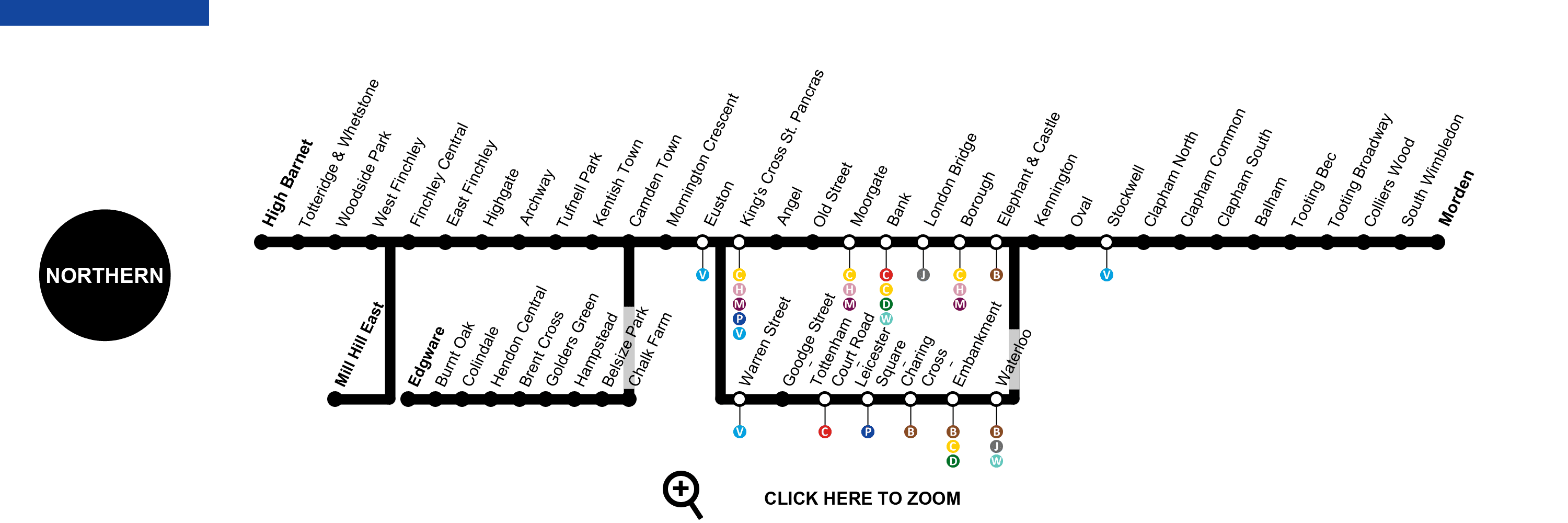
Northern Line overview
The Northern Line is one of the most important north-south London Underground lines. It runs from northern branches including Edgware, High Barnet and Mill Hill East, then crosses central London via two different central routes before continuing south towards Morden or the extension to Battersea Power Station.
For tourists, the line is especially useful because it serves a rare combination of practical places and iconic visitor districts: Camden Town for markets, Leicester Square for cinemas and West End access, Waterloo for South Bank, London Bridge for Borough Market and The Shard, and King’s Cross St Pancras for Eurostar and national rail connections.
- Main tourist strength: strong central London usefulness with multiple famous districts
- Main transport strength: King’s Cross, Euston, Waterloo and London Bridge connections
- Main central distinction: two central branches via Bank and Charing Cross
- Best for: visitors combining sightseeing with practical transport needs
Why the Northern Line is so useful for tourists
The Northern Line is one of the best lines for visitors because it combines cultural, practical and transport value. Some lines are mainly good for shopping, some for airport access, some for events. The Northern Line is different because it connects markets, major stations, attractions, business areas and south-side destinations in one system.
For example, in one day you might use it to visit Camden Town, continue to Leicester Square, then travel to Waterloo for the South Bank, and later move to London Bridge for Borough Market or The Shard. That type of itinerary is where the Northern Line becomes particularly valuable.
It is also very useful for visitors arriving by train, because it connects strongly with Euston, King’s Cross St Pancras, Waterloo and London Bridge.
How the Northern Line works: the key thing tourists need to understand
The Northern Line can feel confusing at first because it does not work like a simple straight line. There are two main things to understand:
- There are several northern branches – trains can come from Edgware, High Barnet or Mill Hill East.
- There are two main central routes – one route goes via Bank, and the other goes via Charing Cross, Leicester Square and Waterloo.
For tourists, this matters because the route you need depends on your destination. If you want Waterloo, Leicester Square or Charing Cross, you usually want the Charing Cross branch. If you want Bank or Moorgate, you need the Bank branch.
The easiest rule is simple: always check the destination and branch shown on the train before boarding.
When should you use the Northern Line?
You should use the Northern Line when your route naturally includes north-south central London travel, one of its major rail hubs, or a key visitor area on the line.
- Use it for Camden Town: yes
- Use it for Leicester Square: yes
- Use it for Waterloo: yes, if you are on the Charing Cross branch
- Use it for London Bridge: yes, via the Bank branch
- Use it for King’s Cross St Pancras: yes
- Use it for Battersea Power Station: yes
- Use it for a simple bank / business trip into the City: yes, via the Bank branch
If your itinerary includes markets, theatres, big stations or practical central London movement between north and south of the city, the Northern Line is often one of the most useful choices.
Who should use the Northern Line?
- Tourists visiting Camden Town and nearby north London districts
- Visitors staying near or arriving via Euston or King’s Cross St Pancras
- Travellers going to Leicester Square, Charing Cross or Waterloo
- Visitors heading to London Bridge, Borough or the City of London
- People visiting Battersea Power Station or south London areas on the Morden branch
Key Northern Line stations (quick overview)
| Station | Zone | Why it matters |
|---|---|---|
| Camden Town | Zone 2 | Camden Market and branch decision point |
| King’s Cross St Pancras | Zone 1 | Eurostar, national rail and one of London’s biggest interchanges |
| Leicester Square | Zone 1 | West End, cinemas and central entertainment |
| Waterloo | Zone 1 | South Bank, London Eye and major rail hub |
| London Bridge | Zone 1 | Borough Market, The Shard and rail connections |
| Bank | Zone 1 | City of London and major interchange |
| Battersea Power Station | Zone 1 | Modern destination, shopping and riverside regeneration area |
Best Northern Line stations for tourists
Some Northern Line stations are especially strong from a visitor point of view because they combine landmarks, transport convenience and itinerary value.
- Camden Town – the most famous Northern Line station for markets, food and north London atmosphere
- King’s Cross St Pancras – one of the most important and useful stations in London
- Leicester Square – very useful for West End, Soho and theatre access
- Charing Cross – practical for Trafalgar Square and central sightseeing
- Embankment – useful for the riverfront and nearby central landmarks
- Waterloo – essential for the South Bank and a major rail connection point
- London Bridge – one of the best mixed-use tourist and transport stations in London
- Bank – very useful for the City of London and onward financial district travel
- Battersea Power Station – increasingly relevant for modern visitor trips
How to use the Northern Line (real tourist routes)
Camden Town → Leicester Square
A very common tourist route if you want to move from Camden Market and the north London atmosphere into the heart of cinemas, theatres and central entertainment.
King’s Cross St Pancras → Leicester Square
One of the most practical routes for Eurostar and national rail arrivals heading straight into central London.
Leicester Square → Waterloo
A strong route for anyone moving from the West End to the South Bank and London Eye area.
Waterloo → London Bridge
Useful for linking the South Bank area with Borough Market, The Shard and one of London’s biggest transport hubs.
London Bridge → Bank
A short but very useful route if you want to move from the south side of the river into the City of London.
Kennington → Battersea Power Station
A practical route if you want to explore the newer riverside regeneration area and modern attractions near Battersea.
Northern Line branches and route structure
The Northern Line is more complex than many other lines because it combines several route patterns:
- Edgware branch – via Camden Town and the Charing Cross side
- High Barnet branch – via King’s Cross, Angel and Bank-side destinations depending on service pattern
- Mill Hill East branch – a short spur off Finchley Central
- Bank branch – serving Bank, London Bridge and Borough
- Charing Cross branch – serving Leicester Square, Charing Cross, Embankment and Waterloo
- Southern route – continuing to Morden, with the extension from Kennington to Nine Elms and Battersea Power Station
For tourists, the two central branches are the most important distinction. If you choose the wrong central branch, you may still reach your wider destination zone, but less directly than expected.
Northern Line stations and route logic
The Northern Line serves 52 stations in total, making it one of the biggest and most useful lines on the network.
Main stations most relevant for tourists
Edgware, Camden Town, Euston, King’s Cross St Pancras, Leicester Square, Charing Cross, Embankment, Waterloo, Bank, London Bridge, Borough, Elephant & Castle, Kennington, Nine Elms, Battersea Power Station and Morden.
Other important branch stations
High Barnet, Totteridge & Whetstone, Woodside Park, West Finchley, Finchley Central, Mill Hill East, East Finchley, Highgate, Archway, Tufnell Park, Kentish Town, Burnt Oak, Colindale, Hendon Central, Brent Cross, Golders Green, Hampstead, Belsize Park, Chalk Farm, Mornington Crescent, Warren Street, Goodge Street, Tottenham Court Road, Angel, Old Street, Moorgate, Oval, Stockwell, Clapham North, Clapham Common, Clapham South, Balham, Tooting Bec, Tooting Broadway, Colliers Wood and South Wimbledon.
Important Northern Line connections
The Northern Line is one of the strongest lines for useful interchanges and rail-related journeys.
- Euston – Victoria line, National Rail and London Overground
- Warren Street – Victoria line
- Tottenham Court Road – Central line and Elizabeth line
- Leicester Square – Piccadilly line
- Charing Cross – Bakerloo line and National Rail
- Embankment – Bakerloo, Circle and District lines
- Waterloo – Bakerloo, Jubilee, Waterloo & City and National Rail
- King’s Cross St Pancras – Circle, Hammersmith & City, Metropolitan, Piccadilly and Victoria lines plus major rail services
- Moorgate – Circle, Hammersmith & City and Metropolitan lines
- Bank – Central line, Waterloo & City line, DLR and access to Monument connections
- London Bridge – Jubilee line and National Rail
- Stockwell – Victoria line
Northern Line for rail, airport and station travel
The Northern Line is one of the most useful lines for visitors arriving by train because it connects several of London’s biggest national and international rail hubs.
- Euston – useful for north England and Scotland routes
- King’s Cross St Pancras – essential for Eurostar, northbound rail routes and several airport-related onward options
- Waterloo – one of London’s biggest stations for southern rail travel
- London Bridge – strong rail hub with useful south-side connections
- Charing Cross – useful for South East England rail travel
The Northern Line does not directly serve Heathrow Airport, but it is still very important in airport-related journeys because it helps connect visitors to the main stations from which onward airport rail routes are available.
Tourist attractions on the Northern Line
The Northern Line serves several very high-value tourist areas and attractions.
- Camden Market – near Camden Town
- West End and Leicester Square area – near Leicester Square
- Trafalgar Square area – near Charing Cross
- South Bank and London Eye – near Waterloo
- Borough Market and The Shard – near London Bridge
- The Oval cricket ground – near Oval
- Battersea Power Station development area – at Battersea Power Station
- Royal Air Force Museum – near Colindale
Northern Line vs other London Tube lines
The Northern Line is not the fastest or simplest line in every situation, but it is one of the most broadly useful.
- Northern vs Jubilee: the Jubilee Line is often better for Westminster to Canary Wharf-type journeys, while the Northern Line is stronger for Camden, Waterloo, London Bridge and Bank patterns
- Northern vs Central: the Central Line is usually better for fast east-west travel, while the Northern Line is better for several north-south central routes
- Northern vs Piccadilly: the Piccadilly Line is stronger for Heathrow and some museum / airport routes, while the Northern Line is stronger for Camden, Leicester Square and London Bridge-type journeys
- Northern vs Bakerloo: the Northern Line generally serves more practical visitor hubs and has broader central usefulness
When the Northern Line is not the best choice
A truly useful page should also explain when the Northern Line may not be the ideal option.
- If you are confused by branch structure and another direct line is available, another route may be easier
- If your journey is purely east-west, the Central Line may be better
- If your trip is Heathrow-focused, a more airport-specific route is usually more practical
- If you are travelling during very busy periods, interchange-heavy journeys may feel more stressful
Northern Line ticket tips
For most visitors, it is cheaper and easier to use contactless payment or an Oyster card rather than buying paper single tickets.
If you plan to use the Tube several times in one day, understanding daily fare caps can help you avoid overspending.
👉 Compare London Tube tickets, Oyster and contactless options
Northern Line service status
Because of the line’s branches and central route complexity, checking live status is always a good idea before travelling, especially during weekends or engineering works.
👉 Check the official Northern Line service status on TfL
Northern Line timetable
The Northern Line runs every day, but exact first and last train times vary depending on the branch, destination and day of the week. If you are travelling very early, very late or into one of the outer branches, it is best to check the latest timetable before travelling.
👉 Check the official Northern Line timetable on TfL
FAQ – Northern Line
Is the Northern Line good for tourists?
Yes. It is one of the most useful Tube lines for tourists because it connects markets, theatres, major stations, South Bank destinations and key central hubs.
Why is the Northern Line confusing?
Because it has several branches and two main central routes via Bank and Charing Cross. Always check the branch shown on the train.
Is the Northern Line good for Camden Town?
Yes. Camden Town is one of the best-known stations on the line and one of the line’s strongest tourist stops.
Does the Northern Line go to Waterloo?
Yes, via the Charing Cross side of the central route.
Does the Northern Line go to London Bridge?
Yes, via the Bank branch.
Does the Northern Line go to Battersea Power Station?
Yes. The extension via Nine Elms continues from Kennington to Battersea Power Station.
Related London Underground guides
- Central Line London guide
- Jubilee Line London guide
- Piccadilly Line London guide
- Bakerloo Line London guide
- Victoria Line London guide
- London Tube Tickets guide